

Keeping the Lights On
Staying Human in Dark Times

I grew up in an American golden age as we wreaked havoc across the world, albeit sometimes with good intentions. Now that havoc, in the same form of dwindling resources, acquisitive enemies, and a government of strongmen and oligarchs supported by overseas agents provocateurs, has come home.
I feel my powerlessness and my complicity. I deeply fear what’s next, not so much for me as for my children’s families and their children’s children.
I most fear that we are being taught to distrust and mock one another, allowing ourselves to be dehumanized, broken in all the ways that are crucial to keeping the species alive as it is meant to be.
We have evolved as social animals who care about and respect one another as a matter of necessity. Without one another, we die.
When I think of what makes us human, I come up with lists like this:
Commitment to one another
Living not just for self-protection but for family, romance, community, art, knowledge, passion, belief, even work.
We seek understanding for ourselves and wonder why we are here among the stars.
Most of us, if you probed, would say we believe in something larger than ourselves, even if it’s nothingness.
It seems to me that we aren’t wrong in our wonder and believing. Given how self-destructive we can be as a species, something larger than we are must be benign and benevolent even toward us, or we would be gone. The universe must derive some benefit from keeping our species alive or it would have welcomed our suicide. Our survival must be connected to forces much larger than our own.
We sense these as spiritual, the roots of our intangible but nevertheless existential experiences of awe, joy, unconditional love, and commitment to more than ourselves.
I think societies live on because they keep to three basic human qualities: mutuality, morality, and awe.
In times of social dissolution, human survival depends on individuals’ commitment to what is best in themselves and necessary to the species. They need to stay close to the matches of compassion, love, commitment and all the others as the lights threaten to go out.
If I believe this, then it’s time to do my job. I’m old, and I can’t do many things I might have done. But I can take the fear and foreboding I feel and prepare to keep to the best of who I am, whatever happens.
How might I stay a moral, questioning, strong person when all the supports and struts I’ve leaned on my whole life—the rhythms of everyday life, my blessedly sufficient pension, peace and quiet, safety—are under threat?
What am I most afraid of? What will I do if my family is threatened?
Can I bring mutuality, morality and awe to my own everyday awareness and hold them fast? Can I make them what I do and how I live?
How and who and what do I want to defend, not with guns and walls but with wisdom and hope?
I knew a young woman who lived for four years under the genocidal regime of the Khmer Rouge. She said to me:
“I would say to myself, ‘they may take my body, but they will never take my soul.’”
Never one to let things lie, I asked, “And did you keep it?”
“Yes,” she said evenly.
She’s a role model for me. She thought ahead about something no one could take from her—the widest and deepest sense of herself. I would like to hold to that in me, but how?
Maybe my efforts will be of use to others who feel the same pressures I do. I think I’ll find that the way lies in a relatively simple moral code and a spiritually driven way of life.
Can I live a life of mutuality, morality, and awe, growing it like a plant, keeping it real and strong?
Ultimately, we have just one moral duty: to reclaim large areas of peace in ourselves, more and more peace, and to reflect it towards others.
– Etty Hillesum, Dutch Jewish author & diarist
About Roberta Culbertson
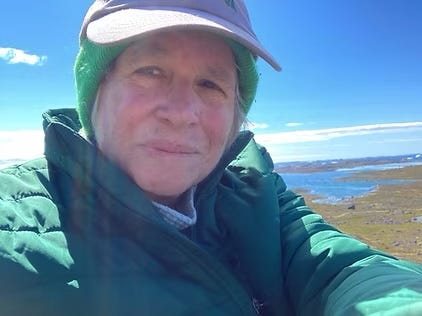
I practice Buddhism. I am a Buddhist, but not necessarily a very good one. I am not a teacher or a monastic, nor even currently a formal student. Nevertheless, in thirty years I have, if not continuously, at least diligently and earnestly studied and practiced Theravada (South Asian), Vajrayana (from Tibet, Nepal, and Bhutan), and Zen Buddhism (Japanese) in forms they are presently being taught in the US. I have been taught by some of the first generation of American teachers, including Pema Chodron, Reggie Ray, John Daido Loori and Dan-En Bennage. and also by relocated classic teachers with a Western bent, like Mingyur Rinpoche, Khandro Rinpoche, and Lama Karma Chopal, a student of Tai Situpa Rinpoche who is my root teacher in the Vajrayana.
I am a master of none of these forms of Buddhism. I have sometimes been a tortured and scattered student rather than a dedicated one. But I think this makes me like many American Buddhist wannabes. If you are one of these, maybe you will find some of my observations to be of help. I am writing what comes. I am not teaching Buddhism here; I am trying to show how one person lives it.
I write for survivors of violence in particular, as I believe we have a long and complicated path to the door of any faith. I write about how I approach the standard practices of Buddhism, from meditation to concentrated study and body discipline, from the perspective of one who feels or felt dead, depressed, anxious and afraid.
I am an anthropologist and chaplain by training. I received my Ph.D. from the University of Virginia, and studied chaplaincy at the University of Virginia Hospital. I founded and ran a residential fellowship program at the University for many years, supporting survivors of war, genocide, and mass and systematic violence as “scholars of their own experience.” There, my colleagues and I focused on the long term, intimate effects of violence, including survivor spirituality. I now live on a farm in Virginia as a full-time Buddhist practitioner, balancing my days between full-time study and a small community and family. I weave baskets, study Complexity theory and Buddhist texts and interpretations, and spend a lot of time on Zoom with a growing sangha of virtual Dharma relatives.